

If you’re a foodie visiting Manchester in the UK, I’m sure you’ll want to try as many traditional foods as possible. As a food-lover myself, I wasn’t satisfied with only trying typical British foods – so, I wanted to create a UK food guide with local foods that actually originated in Manchester.
I’ve compiled this food guide with 10 of the best foods and drinks from Manchester that you must try during your UK trip – and where to eat them!
What food is Manchester famous for?
As one of the most vibrant cities in the UK, the food scene in Manchester is a rich blend of traditional British dishes, multicultural influences, and modern dining.
Many of the traditional foods loved by Mancunians date back centuries, and are also popular across other parts of Northern England. Nonetheless, Manchester has a prominent industrial past, which resulted in regional hearty, comfort dishes that were once central to the diet of the local working-class families.
More recently, Manchester’s food scene is leaning heavily towards modernising classic dishes, innovating and pushing the boundaries of its gastronomic landscape. It’s a very exciting city for foodies!

Visiting soon? Check out my recommendation for where to stay in Manchester for foodies!
Best Food in Manchester, UK: 10 Traditional Foods and Drinks to Try
1. Manchester Egg
You’ve probably heard of scotch eggs, but did you know Manchester has its own version of this famous British speciality?
Instead of a boiled egg at the centre, the original Manchester egg used a pickled egg, which gave it a slightly tangy flavour, and the coating uses Japanese panko instead of regular breadcrumbs. Most importantly, instead of wrapping the egg in the traditional pork sausage meat, the Manchester egg uses a mix of pork and Bury black pudding – a traditional product from the town of Bury, near Manchester.
Manchester eggs are usually served alongside piccalilli (a traditional British relish) or Oxford sauce, and they pair very well with beer (just as any decent British snack should). Nowadays, it’s rare to find the pickled egg at the centre, because apparently people don’t like pickled eggs very much.

Where to eat it
The Manchester egg is a fairly recent invention, created in 2010 by Ben Holden at The Castle Hotel. The little snack became such a success that many pubs and restaurants started serving their own versions. The Abel Heywood Pub still serves them, as does the Modern British restaurant Elnecot.
2. Vimto
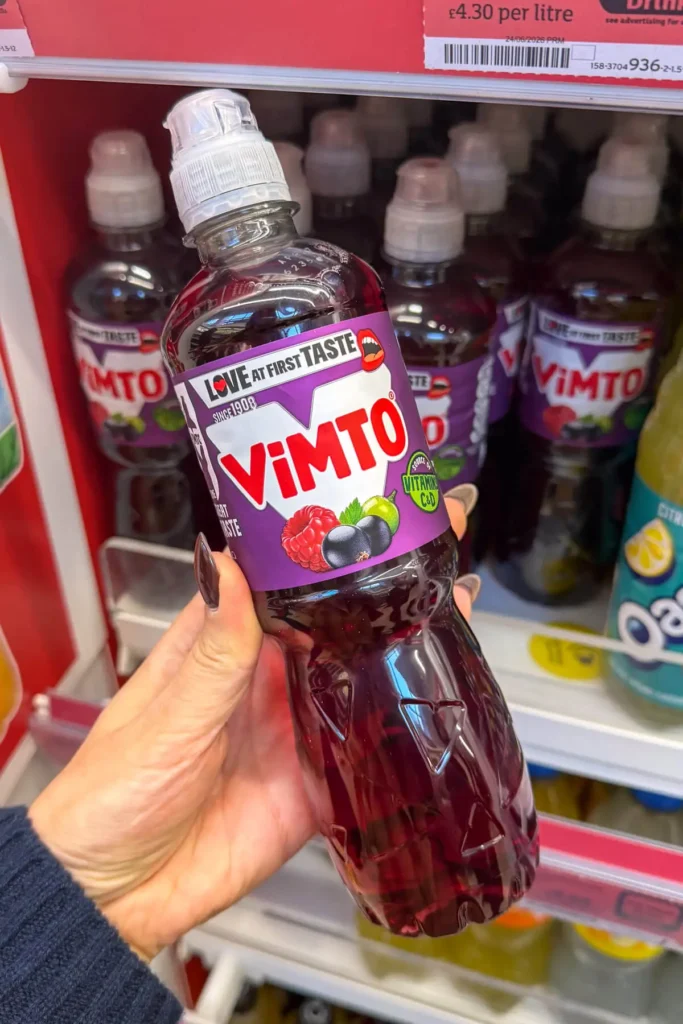
Vimto is probably the most well-known drink associated with Manchester. It’s a soft drink made with the juice of grapes, raspberries, and blackcurrants, and flavoured with herbs and spices.
The exact recipe is a heavily-guarded secret, apparently only known by very few people! The drink was invented in 1908 by John Noel Nichols in Manchester, originally sold as a health tonic under the name Vim Tonic (with “Vim” standing for “vigour”), and soon after shortened to Vimto and sold as a cordial.
Nowadays, there are many variations of Vimto – from still to sparkling versions, energy drinks, and even in slush form. You can also find it in alternative flavours like watermelon and blue raspberry.
Where to drink it
You can easily find Vimto in grocery stores like Sainsbury’s, Tesco, and Waitrose – not only in Manchester, but widely across the UK. It’s such a popular drink that you can order it at most restaurants, cafes, and bars in Manchester.
3. Rag Pudding
If you’re unfamiliar with British cuisine terminology, it can be a bit confusing to understand what a rag pudding is. It’s not a dessert, nor is it eaten with a spoon.
Rag pudding is a savoury dish – a suet pastry parcel filled with minced meat and onions. It’s called this because the pastry parcel was originally wrapped in a cheesecloth (a “rag”) before steaming or boiling. Usually, it’s served with chips, mushy peas, and gravy.
This dish is heavily associated with the town of Oldham, part of Greater Manchester, and a strong example of 19th-century Victorian-era cuisine (although some believe it may already have been around well before then).
Where to eat it
If we’re honest, rag puddings can be hard to find in Manchester’s city centre nowadays, so you’ll need to hunt a bit further out for one. As an Oldham specialty, you can try rag pudding at local fish & chip shops like the Old Plough Chippy, or in other areas such as Sykes Fish & Chips in Swinton, or The Olde Boar’s Head, in Middleton.
4. Manchester tart
The popular Manchester tart is a must-try for any foodies visiting the city! It’s a shortcrust pastry tart with a spread of raspberry jam at the bottom, topped with a set custard layer, and classically sprinkled with flaked coconut and a maraschino cherry. It’s an evolution of a 19th-century recipe called Manchester Pudding.
Manchester tarts were a popular dessert served in UK schools post-war, between the 50s and 80s, so they’ve understandably become a very nostalgic food for Brits.
Sometimes, school canteens would slot banana slices under the custard, making many people associate bananas with the dessert. However, this is a modern variation, and true purists still agree that bananas should have no place in a classic Manchester tart. You can try both and decide for yourself which one you prefer!
Where to eat it
Sadly, Robinson’s Bakery – Manchester’s oldest family-run bakery for nearly 160 years, and which used to be one of the best places to buy an original Manchester tart – closed down in 2023. Locals seem to agree that the next best place to get a classic Manchester tart is at Bury Market.
If you prefer to stay around the city centre, you can still find modern versions at cafes and bakeries like Morning Glory, or at classic pubs like Founder’s Hall and Sam’s Chop House.
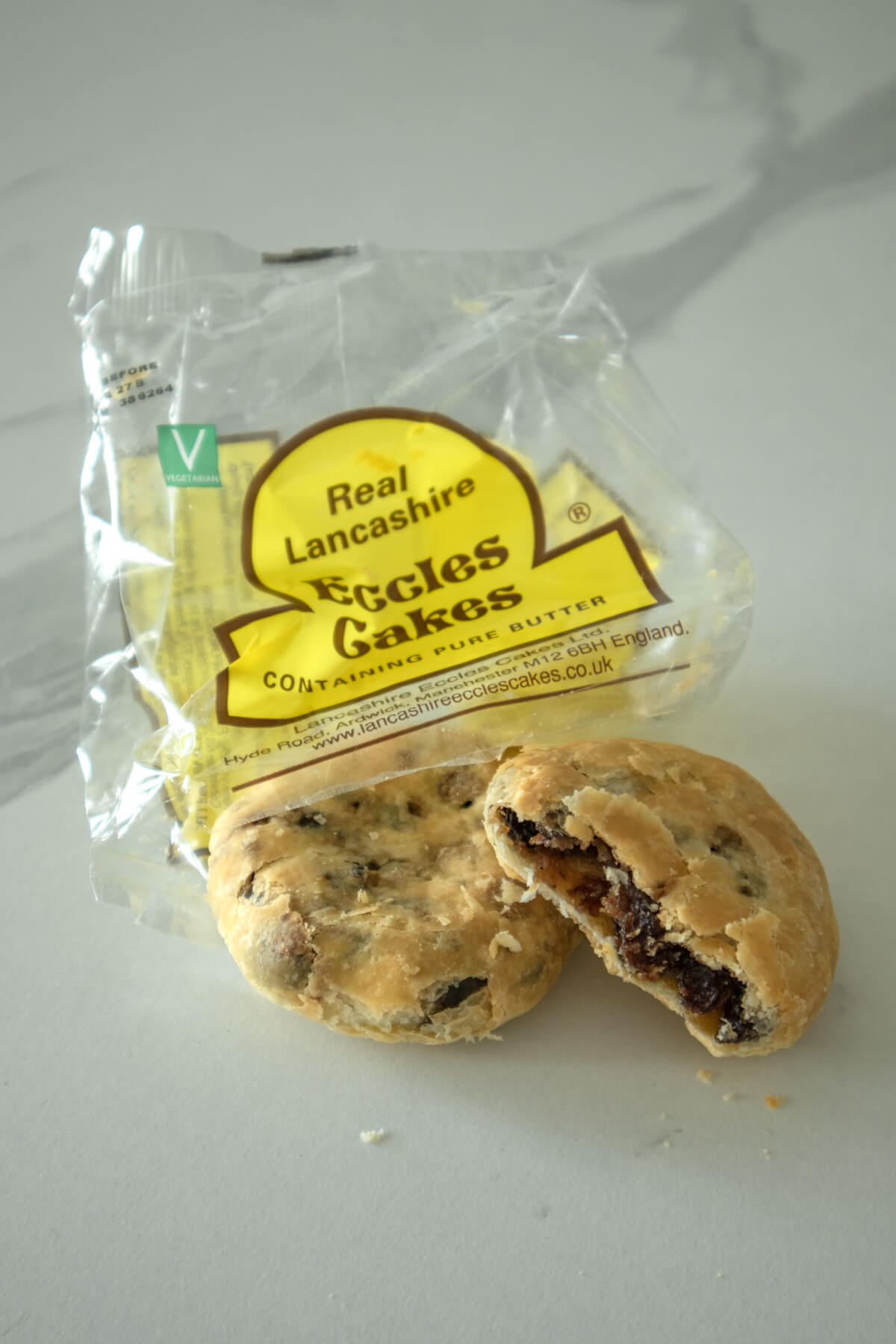
5. Eccles Cake
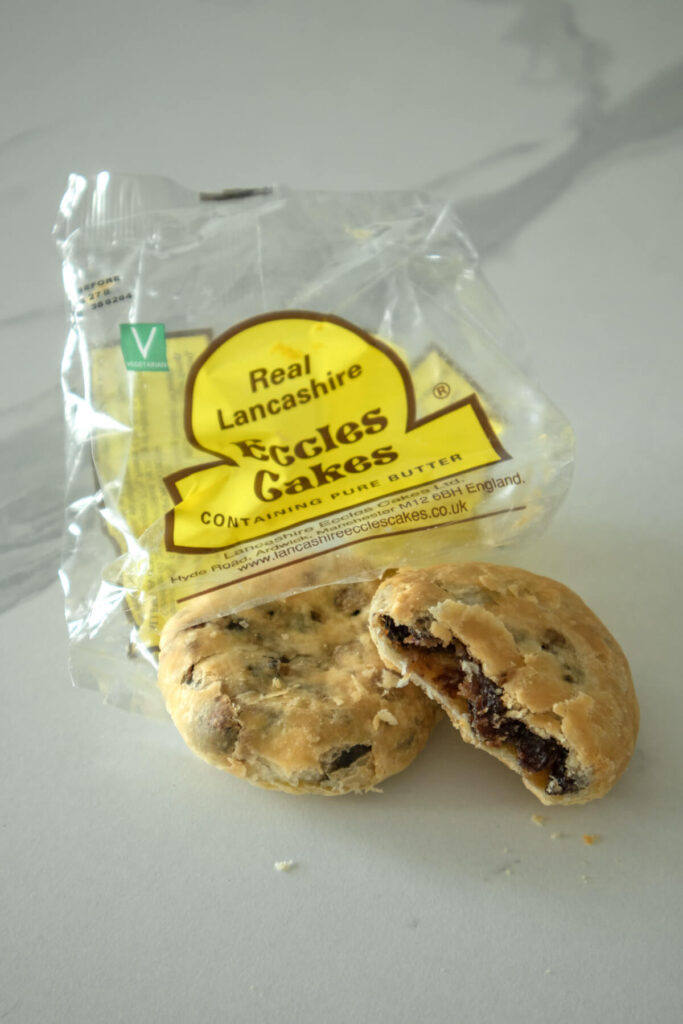
Eccles cakes are traditional buttery flaky pastries filled with currants, and sometimes dusted with sugar.
These little cakes are named after the town of Eccles (now part of Greater Manchester), as they’ve been historically linked to the town’s religious festivals and holidays. For this reason, Eccles cakes were banned during the Puritan years of the 17th century!
After the Restoration of the Monarchy, Eccles cakes were allowed once again, and we know the modern version was first sold by James Birch at his shop in Eccles town centre in 1793. You can enjoy Eccles cakes at room temperature or warmed up – Brits particularly like pairing them with Lancashire cheese and/or a cup of tea.
Where to eat it
Eccles cakes are so popular in the UK (and even abroad) that you can find pre-packaged Real Lancashire Eccles Cakes in grocery stores all over the country.
Fresh options are trickier to come by in Manchester’s city centre, but the best places to look are the local makers’ markets at St Ann’s Square, Piccadilly Gardens, or in the Northern Quarter, if they coincide with your trip dates!
6. Boddingtons Bitter Beer
Boddingtons Bitter is a flagship beer known as “the Cream of Manchester”, historically brewed for over 200 years at Boddingtons Brewery just outside the city.
The brewery actually has a fascinating history involving poisonings, bombings, and business moves (I really recommending reading this article if you’re interested in this). Ultimately, after a very prosperous period in the 80s and 90s, the brewery closed down in 2004 and production moved away from Manchester.
On a positive note, in 2025, J.W. Lees (Manchester’s oldest operating brewery of almost 200 years) announced they’d relaunched Boddingtons Cask Ale as its exclusive brewer, bringing production back to the city. Despite the decline in popularity, Boddingtons Bitter still remains an important part of Manchester’s heritage.
Where to drink it
If you’re looking for a pint of Boddingtons Bitter in the city, choose a pub who serves it on draught like Founder’s Hall, Sam’s Chop House, and others listed here.
Alternatively, Boddingtons Bitter is also sold in cans at grocery stores across the UK such as Tesco, Sainsbury’s, and Morrisons.
7. Lancashire Hotpot
The Lancashire hotpot is a slow-cooked stew made with lamb/mutton, onions, sliced potatoes, and sometimes, lamb kidneys – usually served with shredded, pickled red cabbage. Originally, people would add oysters (which used to be a “poor man’s food”) to bulk up the stew, but not anymore.
The exact origin of the dish is likely much older than we know, but it was a very popular working-class meal during the industrial revolution in the county of Lancashire (which included Manchester at the time). As a way for families to eat cheaply and conveniently, they would assemble the hotpot and leave it to slow-cook for hours until they came home from work.
Where to eat it
The Lancashire hotpot is one of those dishes that are best found in family homes (and each household will have their own recipe variation) – but you can still find it at Manchester’s historic Mr Thomas’s Chop House.
8. Cloudwater Craft Beer
If you’re a fan of craft beer, you’ll be happy to know that Manchester is home to one of the UK’s best-regarded independent breweries, Cloudwater.
Cloudwater was founded in Manchester in 2014, but despite its young history, it rapidly exploded in popularity (both in the UK and abroad) for its quality and style, getting global top rankings just within its first few years.
Originally, Cloudwater focused on seasonal releases, but now they offer anything from pale ales to lagers, hazy double IPAs, barrel-aged beer, and low/no-alcohol beers. They release new beers each week (yes, really) so you’ll certainly find something you like among their range.
Where to drink it
You know I always advocate for trying foods and drinks at their source, whenever possible. So, of course, the best places to taste Cloudwater craft beer are the brewery’s own taproom, or their pub, Sadler’s Cat, near Manchester Victoria station.
9. Chips, Gravy, and “Manchester Caviar”
Alright, so here’s another example of Northern British food which isn’t exactly unique to Manchester, but where the city actually has an interesting piece of history that makes it a must-try when you’re visiting.
There’s a hot debate between Manchester and London regarding which city was the original birthplace of fish and chips. A historic blue plaque at Tommyfield Market in Oldham claims to be the place where the first fried chips were sold in 1860, and from where fish and chips evolved thereafter.
To me, the evidence seems clear that Manchester is the place to try chips and gravy – a combination so beloved in Northern England and which isn’t all that common down south. To top it off, make sure to also add some Manchester caviar – a cheeky way to say “mushy peas” 🙂
Where to eat it
Every Mancunian might have their own favourite local chippy to recommend should you ask, but if you’d like somewhere central and loved by both locals and visitors alike, head to Wright’s Fish & Chips.
10. Corned Beef Hash
Corned beef hash is made with chopped corned (salt-cured) beef, fried potatoes, and onions. In the UK, it’s popularly sold in a can, but specialty restaurants will cure their own beef and cook it from scratch.
Okay, this dish may not have been exactly invented in Manchester – its roots actually date all the way back to the 14th century, and it later solidified itself as a comforting dish across Northern England.
However, I had to include it in this Manchester food guide because corned beef hash is cemented as a signature dish at a few of the city’s historic pubs and chop houses, making it deeply engrained in the city’s food culture. In fact, I think Manchester might arguably be one of the best places in the UK to try this iconic British food staple!
Where to eat it
The most famous corned beef hash in Manchester is served at the historic Sam’s Chop House and at its sister pub, Mr Thomas’s Chop House. Their signature and secret homemade recipe involves brining and marinating the beef for 10 days – so you know that this is one is definitely worth trying!
Where to Stay in Manchester for Foodies
Maybe I’m biased, but based on my previous visits, my favourite area to stay in Manchester is in the Medieval Quarter. This area is perfect if you’re visiting for the first time, as it’s near Victoria Station and very convenient to visit the city’s main sights.
If you love food, many of the hotels in this area have great bars and restaurants, especially on the modern and fine dining front. Some of Manchester’s most iconic historic pubs and chop houses mentioned in this guide are just around the corner, while the Northern Quarter‘s independent bakeries, wine bars, and craft breweries are also within a 10-minute walk.
Hotels I recommend for foodies in Manchester’s Medieval Quarter:
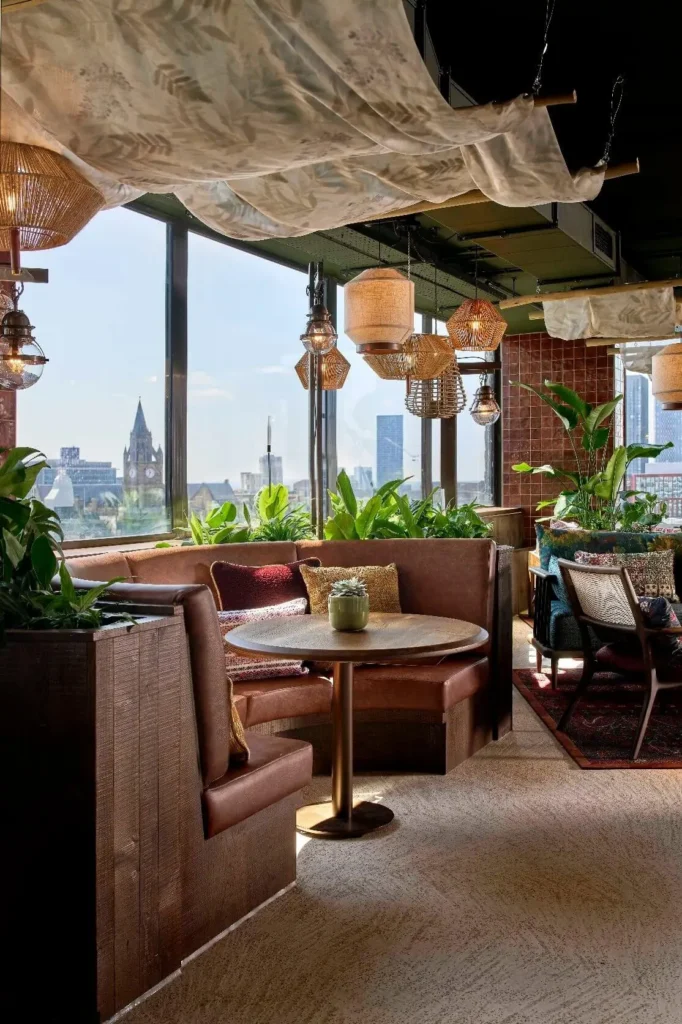
The Treehouse Hotel Manchester is a new hotel right by Deansgate that combines modern, quirky rooms with diverse and sustainable chef-led dining options.
The hotel has a rooftop bar, The Nest, with panoramic views over the city, which is a pretty cool place for drinks, music, and small plates. If you want a more low-key option, they also have a speakeasy on the top floor, called The Hideout!
Apart from the bars, the hotel also has two chef-led restaurants that reflect both sides of Manchester’s culinary scene. Sister Moon is their new Southeast Asian rooftop restaurant. Pip, on the other hand, focuses on seasonal British cuisine with locally-sourced ingredients, which has earned it a spot in the Michelin guide and a few other awards! They also serve a mean Sunday roast, if you’re staying over a weekend.
The Treehouse Hotel also has some cool amenities like a wood-fired sauna and cold plunge, two covered padel courts, and a private cinema.

A few years ago, I also stayed at Hotel Indigo, near Victoria Station and right opposite the National Football Museum. The beds are HUGE, and very cosy for a good night’s sleep.
I would say this hotel is best for a convenient location with comfort and no frills. The hotel has one Mediterranean restaurant and bar, Mamucium (it’s also where they serve the hotel breakfast) which focuses less on British cuisine, but the I found the food and drinks very good. There’s also Todd St Café with a street entrance, which serves light bites, cream tea, and afternoon tea.
Nonetheless, as I mentioned, the Medieval Quarter is very close to Manchester’s Northern Quarter and the retail district, where many of the city’s best restaurants, pubs, and bakeries are – so you can reach them as easily as the rest of Manchester’s sights from here.
Here are more recommendations for hotels in Manchester:
Final thoughts
I hope this local Manchester food guide with the best traditional foods and where to eat them is helpful for your upcoming UK trip! There are many more typical Northern England dishes that you can discover in the city, but this list is a good start for original Manchester specialties.
If you have questions about any part of this post, feel free to reach out in the comments below!
Visiting soon? Check out my UK guides:
Visiting the UK soon and looking for the best food to try in Manchester? Pin this food guide to save it for later!