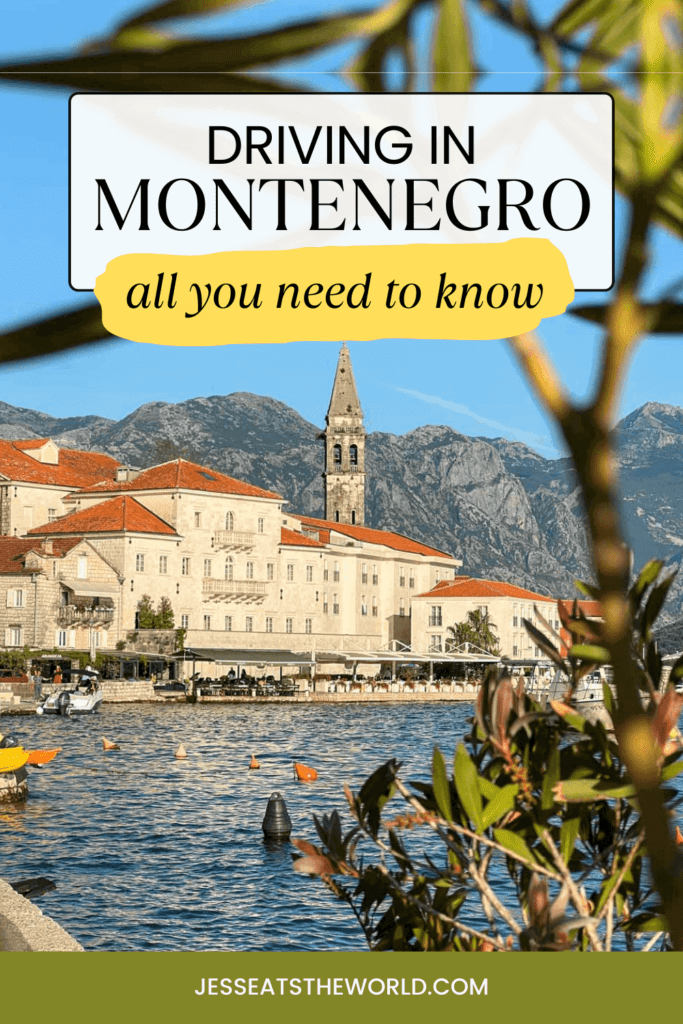

Rising in popularity as an alternative to the most popular destinations in Europe, Montenegro is a small but incredible country to road-trip in. Much like in the rest of the Balkans, driving in Montenegro is often described as risky, but I firmly believe that renting a car is the best way to explore the country!
I’ve written this guide to help ease your concerns if you’ve second-doubted the decision to visit Montenegro by car.
I’m here to share all my tips and experience with you after visiting Montenegro north-to-south by car myself, and hopefully inspiring you to do the same!
Disclosure: This post may contain affiliate links for products or services that I personally endorse and love. Should you make a purchase, I may make a commission at no additional cost to you. Thank you for supporting Jess Eats The World!

Quick tip: I rented a car in Montenegro with Hertz and had a smooth experience with pick-up and drop-off. Book your rental car here!
Things to consider before deciding to drive in Montenegro
Let’s start with a few basics to help you decide whether to rent a car in Montenegro during your trip.
Do you need a car to get around Montenegro?
I always avoid renting a car during my trips, whenever possible. If a country has a good public transport infrastructure, I much prefer taking trains or buses instead of hiring a car, as it’s usually cheaper and I don’t have to worry about fuel, insurance, or parking.
However, while planning my trip to Montenegro, I realised that while Montenegro has public transport and bus networks, relying on public transport alone wouldn’t allow me to complete my itinerary with the time I had without a car.
Depending on your itinerary, you can definitely get around Montenegro without a car by using the public transport systems. However, you will be bound to their schedules and the trips will take significantly longer.
You may also choose to base yourself in one area and take day trips from there by bus or with organised tours. It is much easier to rely on public transport if you are only spending time along the Montenegrin coast. Visiting the National Parks in the north of the country may be trickier. You can use this website as a good resource to find buses to reach various parts of the country.
Here are some day trips you can enjoy in Montenegro without driving:

If you have a tight itinerary, or want to explore Montenegro north-to-south, then I definitely recommend renting a car. It’s the easiest and most convenient way to visit the country, and you can often find great price deals, so it doesn’t have to break the bank either! It also allows you to make any stops you want along the way to check out viewpoints and other sights, spontaneously.
Quick tip: I rented a car in Montenegro with Hertz and had a smooth experience with pick-up and drop-off. Book your rental car here!
Can tourists drive in Montenegro?
Yes – tourists can rent cars and drive in Montenegro, as long as you have the necessary documents required by the rental agency.
If you plan on driving your own car into Montenegro, you must check the documentation and car equipment requirements. Check this website for the requirements to drive a British car in Montenegro.
You can also drive from Dubrovnik to Montenegro (or vice versa), or from Montenegro to Albania, Serbia, or Kosovo with permission from your rental company. Beware that there may be long waits at the borders at certain times of the day (and especially in the summer). Since Montenegro is not part of the Schengen Area, there are border checks when crossing into or out of the country.
Click here to jump to the list of what you need to rent a car in Montenegro further down on this post.

Driving to Albania? Check out my guide on Everything You Need to Know Before Driving in Albania for First-timers!

Is it difficult to drive in Montenegro?
There are many stories out there of unpleasant experiences while driving in the Balkans. I will say that, if you are used to driving in a country where road rules are enforced and strictly followed as the norm (for example, in Germany), you may find it tricky to adjust to the driving habits in Montenegro.
Despite the validity of others’ experiences, driving in Montenegro is not as challenging as it’s usually made out to be.
I would still recommend that you avoid driving at night as much as possible, as many roads may be poorly lit (or not lit at all). If you visit in the summer, note that the roads will also be much busier and traffic jams are common in the afternoon peak hours (between 1-5PM).
Ultimately, if you are aware of what to expect (as I will tell you throughout this post), driving in Montenegro is not difficult, as long as you drive carefully and defensively.
For example, my partner and I have held driver’s licenses for years but always lived in cities where we never drive in (I drive 2-3 times a year at most).
We are neither super experienced nor confident drivers, but we had driven in Albania before and didn’t think twice before renting a car to explore Montenegro and see all its beauty!
Tips and advice for making it easy to drive in Montenegro
Montenegro is a right-hand drive country – you drive on the right and overtake on the left, like in most other European countries.
Montenegro’s road rules are also very similar to those in most of Europe, at least officially. You just have to be triple-aware at intersections and during other encounters with other drivers, as it is safer to always assume that others might not follow the rules as strictly.
When in doubt: stop, give right of way to others, and check twice before taking a turn or merging into a new lane. Stick to speed limits, regardless of how fast others may be driving around you; if you feel like you’re holding up traffic, find an opportunity to stop at the side of the road briefly and let other cars through.
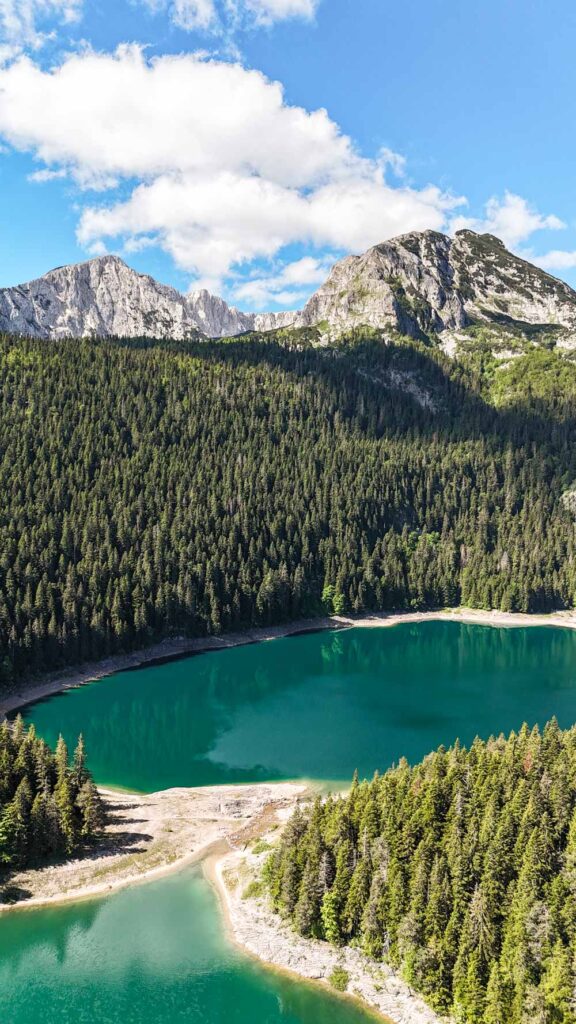
Something else that’s important to note regarding your own driving ability is that many of Montenegro’s roads are mountain roads to some degree, because the country is very mountainous. This means lots of uphill and downhill steep inclines, as well as tight curves with limited visibility.
If you are not a very confident or experienced driver, my number one tip is to rent an automatic car. This is what my partner and I did – it took away a lot of the stress from driving, and allowed us to fully pay attention to the road conditions and being able to react in case we needed to.
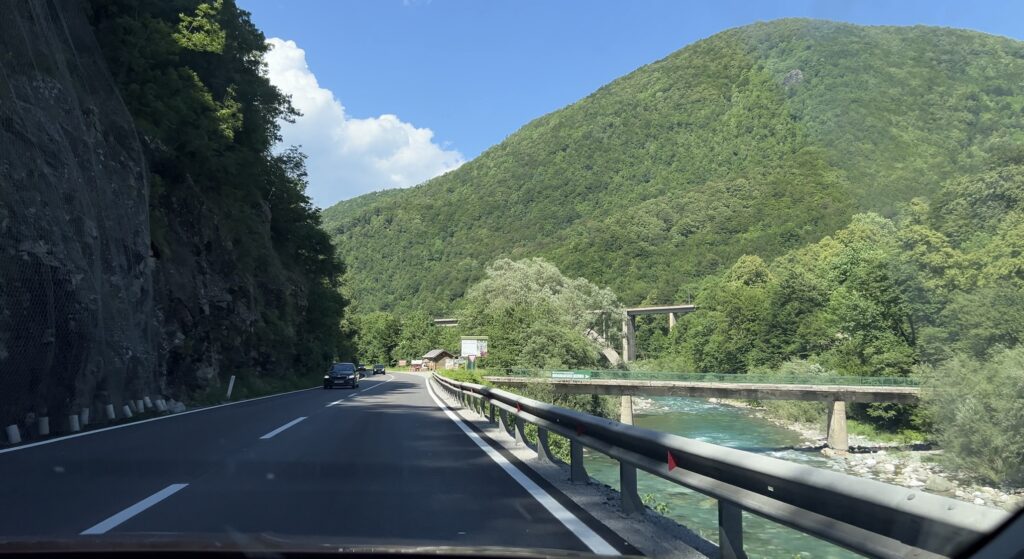
Most of the roads I drove in in Montenegro were in good shape, and we encountered a fair few open roads where we could drive at 80km/h (50mph) or more, making it a smooth experience for the most part when exploring the length of the country. Other than these, mountainous roads have varying speed limits due to steep inclines and tight curves, and we often found ourselves driving under 50km/h (30mph) most of the time.

Tips for driving in Montenegro: everything you need to know
What are the driving rules in Montenegro?
For a deeper dive into Montenegro’s specific driving rules, you can check this website. In short:
- Montenegro is a right-hand drive country – you drive on the right and overtake on the left, like in most other European countries.
- Cars in Montenegro must have their headlights on at all times when driving – the staff at the car rental company should help you ensure the settings are correct during pick-up.
- You can dial 112 in case of emergency – this number works anywhere in Europe, and operators can answer calls in the native language, English, or French.
- If you’re involved in a collision or any accident, you must remain in the car and wait until the police arrive. While I didn’t experience much road rage or any altercations, it is best to avoid confrontation with other drivers.
- Seat belts should be worn by passengers in all seats where a belt is available. Children under 5 years of age must use an appropriate restraint in the back seat, and children up to 12 years old are not allowed in the front passenger seat.
- The police can pull over cars and issue fines on the spot if an infraction is detected. The blood alcohol limit for all drivers is 0.03%, which can be tested by the police at their discretion. The limit is low enough that you cannot have a beer and drive in Montenegro.
- National speed limits vary generally from up to 50km/h (30mph) in built-up areas to 80km/h (50mph) in open roads, and up to 100km/h (60mph) on the A-1 motorway and on faster express routes. Though, it is not uncommon to see speed limits as low as 20-30km/h (12-18mph) on mountain roads.
Road quality: do you need a 4×4 in Montenegro?
If you follow the most popular touristic routes in Montenegro, the majority of roads will be paved and, for at least 95% of travellers, I don’t consider it necessary to rent a (more expensive) 4×4 vehicle.
In fact, it may be more practical to rent a smaller car for managing the winding and narrow mountain roads when exploring Montenegro.
If you do want to venture into off-the-beaten-track remote areas, then yes, I’d recommend you get a 4×4.
The most important thing to remember is that your regular rental car insurance will be voided in case of accident or damage and you are suspected to have gone off-roading (this is the case for most companies and similar in most countries). Off-roading is defined by any driving that happens on non-paved roads – not just in remote areas.
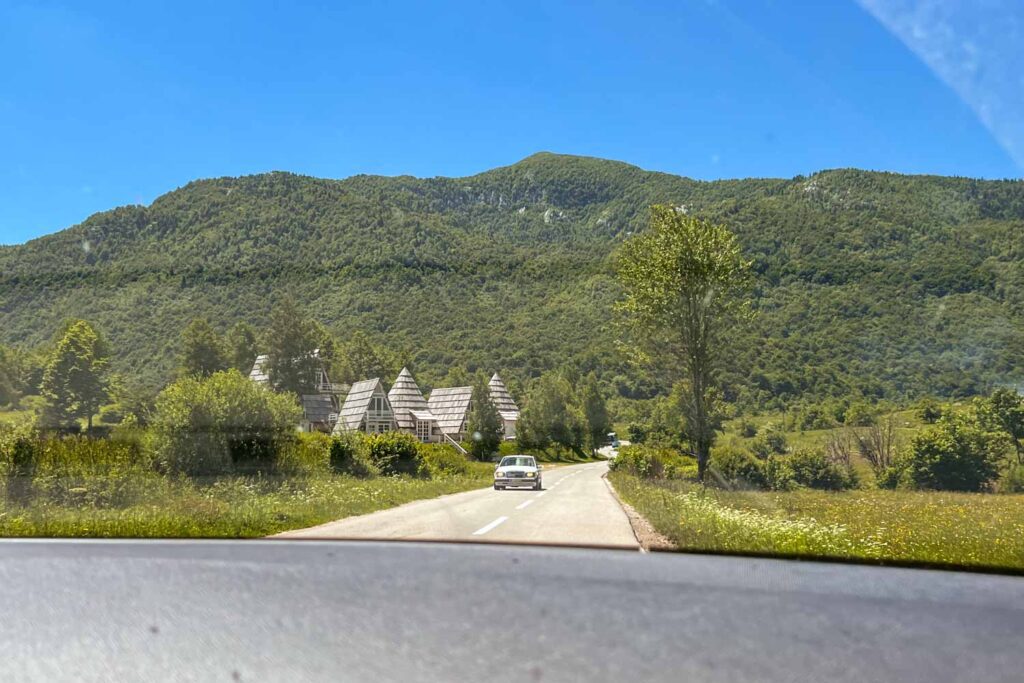
I found Montenegro’s roads to be in very decent condition, especially compared to some of its neighbouring countries. Gravel and dirt roads are common in rural areas, but these are not part of the main tourist routes. If you find yourself in one, try to look for an alternative route via a paved road.
As a general rule, stick to the “E”, “P”, “M”, and “R” roads in Montenegro.
TIP: Give your rental car a quick wash before returning it to the office. It’s easy to find quick self-service car wash establishments for 5 Euros or less in Montenegro.
We learned this lesson on a previous trip, when our car was a little dusty when we dropped it off and the employee asked if we had gone off-roading. Now we always give our rental cars a quick rinse before drop-off, as it avoids doubts (is that a dirt speck or a scratch?), and it also shows that you’ve taken good care of the car.
HOWEVER, depending on when you visit, you may find yourself driving on an open road which briefly turns from asphalt to gravel and dirt, due to road works. Montenegro has been investing in improving its road infrastructure and we encountered this a few times during our journey.
Unfortunately, there was no warning prior to arriving at these sections, so we had to drive very slowly and resume speed once reaching the asphalt again. The same can happen with road closures without warning up to the closed section. If you plan on driving across Montenegro, I recommend double-checking any road closures while planning your route for the day.

Speed limits in Montenegro
National speed limits in Montenegro, as described in the previous section about road rules, generally vary from up to 50km/h (30mph) in built-up areas to 80km/h (50mph) in open roads, and 100km/h (60mph) on the A-1 motorway and a few faster express routes.
Despite this, the nature of many of Montenegro’s mountain roads won’t really allow for a lot of fast driving. When we road-tripped across Montenegro’s mountain roads, we found ourselves driving under 50km/h (30mph) most of the time.
Regardless of how fast others may drive, I advise you to stick to the speed limits. Speed limits are strictly enforced in Montenegro, and the police are allowed to fine you on the spot. Speeding fines in Montenegro can go up to €2000 and, at worst, imprisonment.
My best tip: if you feel like you are holding up traffic (even if you’re sticking to the speed limit), briefly stop at the side of the road (if possible) and let other cars through. We do this often when we feel pressured by other cars behind us. It helps avoid stress and unnecessary speeding.
Overtaking
Overtaking is a national sport in the Balkans. I am sure that if my father, who’s driven for over 30 years in Western Europe, witnessed the Balkan approach to overtaking, his heart would skip three beats. Yet, it seems to be the norm here, so you must be aware of it.
Montenegrins will overtake you anywhere, no matter if it’s a tight curve, a steep mountain road with little to no visibility, at the edge of a cliff road, or if there’s a car coming towards them in the opposite direction. They will even overtake multiple cars at once. We’ve witnessed a few near-misses where cars merged back in at the very last second, just about avoiding a collision with the car in the opposite direction.
I know it can feel disheartening to have other cars overtake you, especially if you’re a nervous driver (it feels like they’re saying “you’re too slow and you’re holding up traffic“). But trust me, you could be driving at twice the speed limit and the drivers here would still overtake you. You’re not the problem.
My best tip: If a car starts overtaking you, slow down gently so that they can get past you, and maintain a decent safety distance until they are back on the right-hand lane. You do not want to compete with them, and you do not want to be too close to their rear if they merge back in abruptly.
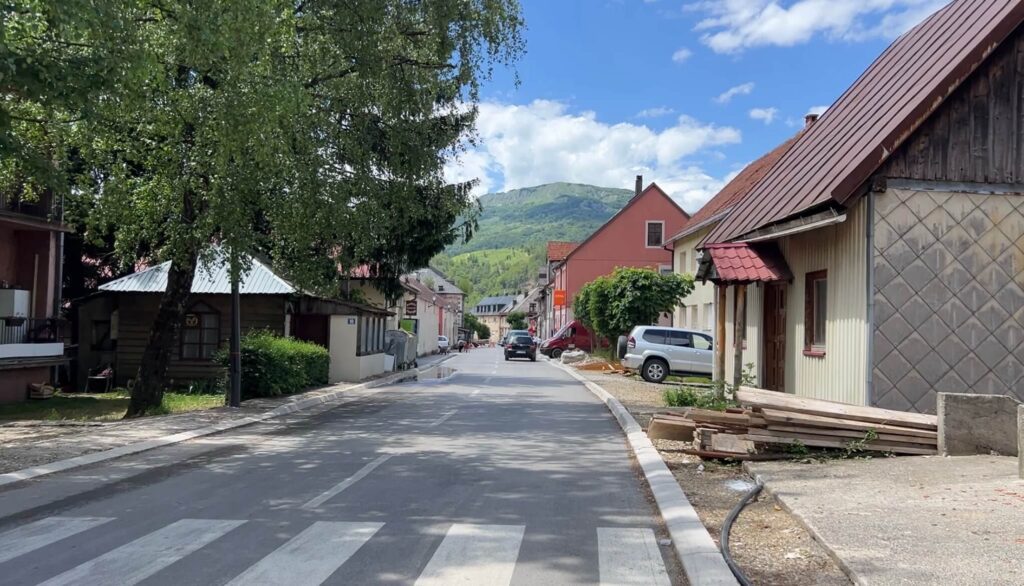
Traffic lights, indicators, and roundabouts
Traffic lights are common in Montenegro, especially in urban areas. However, you must be extra-careful at intersections and roundabouts where there aren’t traffic lights, and in rural areas. Always slow down in the event that a car may come from a secondary road without stopping, and never blindly assume that others will give you right of way.
The use of indicators/blinkers seems to be a suggestion for locals as well; Why is it your business which way they’re going, anyway? Keep your wits about you, and drive defensively, as it’s best to be prepared for anything.
Roundabouts in Montenegro work similarly to other countries in Europe. As a general rule, you must give way to drivers already in the roundabout. Roundabouts are common in most towns and cities in Montenegro – but with the influx of tourists, do not assume that everyone knows how roundabouts work. As with most of my other advice – drive defensively.
Livestock on the road
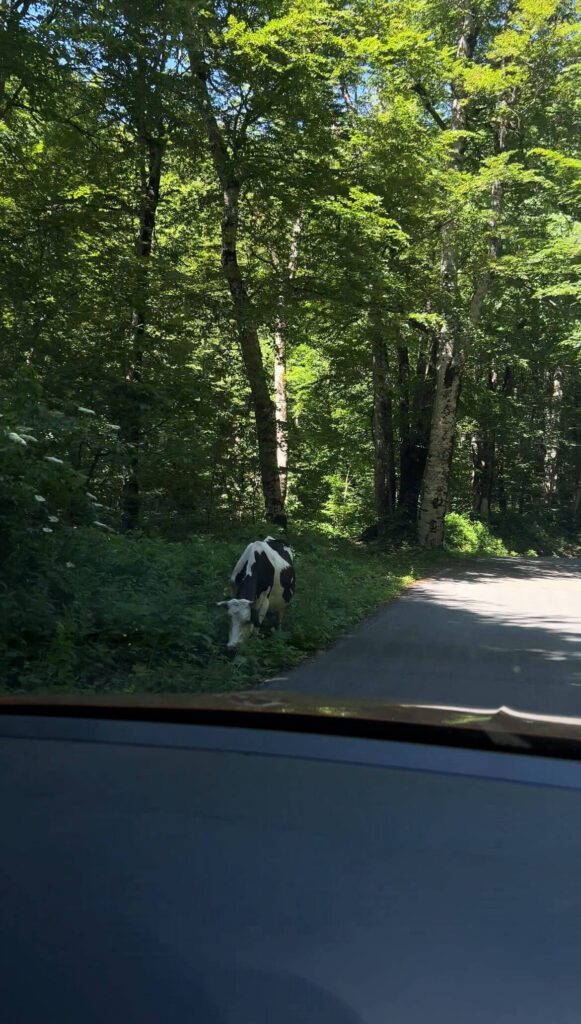
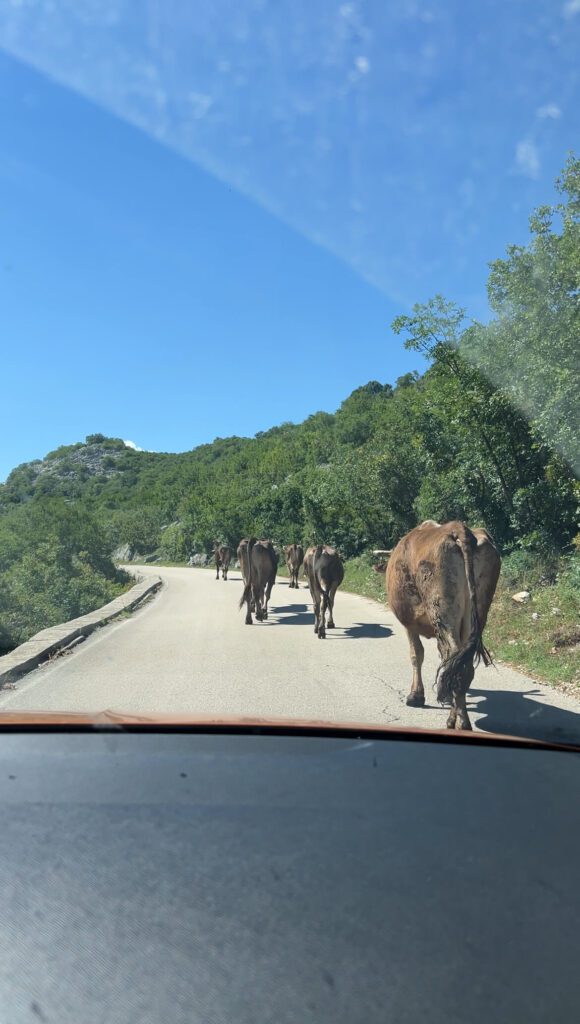
When driving in Montenegro, you must also be specifically prepared for encountering livestock potentially roaming free and wondering on the road. At times, you may get stuck behind shepherds gathering their herd of cows on the side of the road, or you may also find unaccompanied dogs, cats, goats, sheep, or horses.
Don’t trust Google Maps blindly when driving in Montenegro
It’s fine to use Google Maps as a navigation tool in general for driving in Montenegro, as it generally recognises the most popular routes. However, it’s not uncommon for Google Maps to not be able to distinguish paved roads from goat trails in rural areas (as it happened to us).
As a general rule, stick to the “E”, “P”, “M”, and “R” roads in Montenegro.
Do not follow Google Maps blindly – zoom in on the recommended route using the satellite view and assess if it is a good road – otherwise, try an alternative route.
If you want a better navigation tool option (and especially if you’re hiking in Durmitor), download the app Maps.me. It works well in Montenegro and you can also use it offline, which is a big plus!


Don’t forget that EU roaming plans don’t work in Albania! I used an eSIM, which worked perfectly in the Albanian Alps, and was very convenient and easy to use from the moment I landed at the airport.
You can get 5% off Holafly eSIMs with my code “JESSICAVIANA“!
Parking
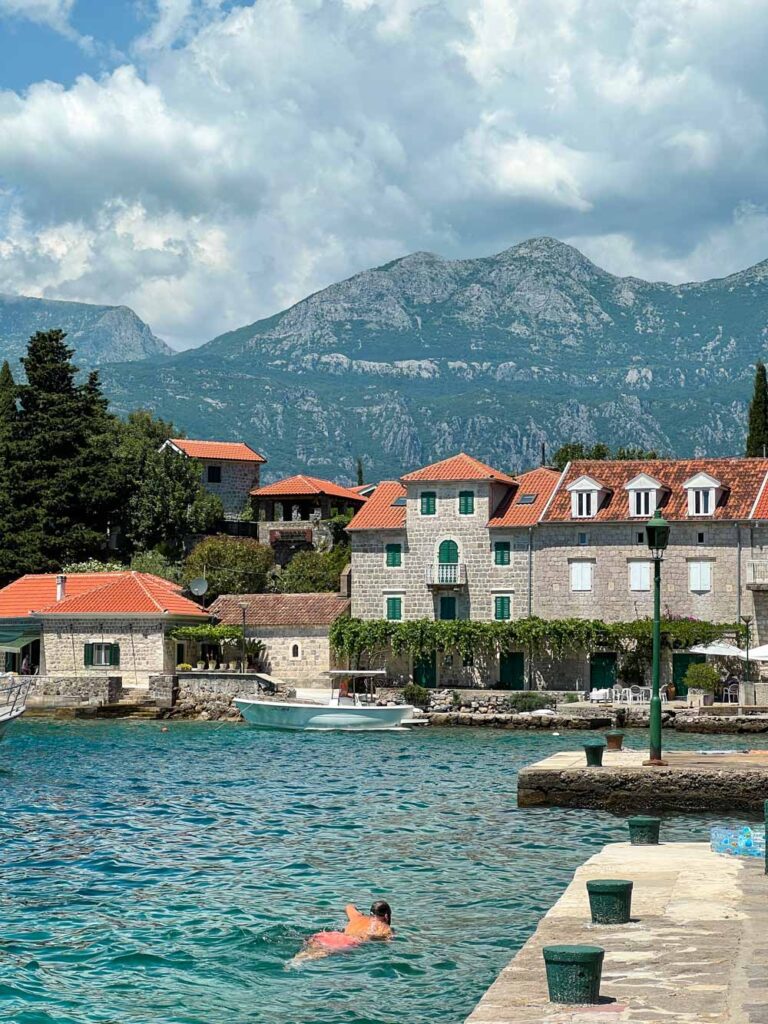
Montenegro has a mix of paid and free parking available in its cities and towns. In peak summer season, parking in Montenegro is not easy. In busy city centres and in pedestrian-only towns (like Perast), it can be difficult (or impossible) to find free parking. It’s always worth carrying some coins with you, just in case.
In smaller towns, it can be easy to find free parking lots or spots, and usually side-of-the-road restaurants have free parking for customers. In busier towns, like Kotor, we got creative and looked for free parking spots slightly outside of the centre but at a reasonable walking distance.
If you’re renting a car, make sure your accommodation offers private parking for guests, so that you don’t have to worry about parking. It’s common for accommodations to have either a private garage or parking spots reserved for overnight guests (for free or paid).
If you are unlucky enough to get a parking ticket, you will need to find a bank or post office and make the payment there. We didn’t have any issues with parking, but fines can range from 15-150 Euros plus towing and storages costs, if applicable.

Can you sleep in your car in Montenegro?
While the country is a great destination for backpacking and exploring its beautiful mountainous scenery and nature, wild camping and free standing with a camper are officially not allowed in Montenegro.
According to the experts at Caravanya, in reality, locals and authorities are tolerant and might turn a blind eye if you are discreet and stay away from tourist areas and beaches. If you find signs warning of prohibited parking or camping, you should respect them.
If you’d like to stay on the safe side, or if you’re looking for a more comfortable experience, there are plenty of affordable designated campsites throughout the country (starting from 15 Euros a night!).
Gas / petrol stations and refuelling
As most of the touristic routes in Montenegro are either along main open roads or in towns and cities, it isn’t difficult to find petrol stations.
You’ll find EKO petrol stations very frequently along the main roads or at the entrance of towns/cities, as it’s one of the main gas station chains in Montenegro. Lukoil, Petrol, and EURO Petrol are other locally-trusted chains. You can pay for fuel with card at most stations in Montenegro.
Toll roads
Montenegro only has one motorway where there is a toll – on the A-1 section connecting Smokovac and Mateševo. We drove through it to go from Podgorica to Kolašin.
Additionally, there is a special toll for all vehicles on the Sozina Tunnel, on the E80 road between Podgorica and Bar.
Should you drive by, it’s possible to pay by cash or card – the toll charges for cars range from 2.5-3.5 Euros, and between 1-1.50 Euros for motorcycles.
What do you need to hire a car in Montenegro?
Renting a car in Montenegro is not much different from renting a car anywhere else in Europe. Here are the requirements and the documents you need:
- The minimum age to rent a car is 21 years old.
- You can rent a car with a full and valid driver’s license from your home country (ie. UK, EU, US), or an International Diver’s Permit if your national driver’s license is not written in Roman script. You must have held your driver’s license for at least one year (some rental companies require longer).
- Most companies require a credit card for deposit. The value of the deposit varies by company (for us it was 500 Euros) and it can take up to a month to be refunded.
- You must get car hire excess insurance – you can get this from the rental company directly, or you can purchase it from a separate insurer. It is usually cheaper to purchase insurance beforehand, rather than signing up for cover at the time of pick-up.
- You do not need a green card for driving in Montenegro. However, the rental company may require that you get a vignette if you plan on driving across borders (to Albania, Croatia, Bosnia, Serbia, or Kosovo).
You can hire a car from a number of different providers, and from private individuals and small operators in Montenegro.
Remember that depending on the demand and time of year, prices can be much higher when renting a car last-minute, versus booking beforehand.
Renting a car in Montenegro itself is not very expensive and usually costs from around 40 Euros per day (but may be much cheaper in low season!).
Quick tip: I rented a car ahead of our Montenegro road trip with Hertz and had a smooth experience with pick-up and drop-off. Book your rental car here!

Final words
Is it worth hiring a car in Montenegro?
In my opinion, it is completely worth renting a car in Montenegro if you want to explore the country to the fullest in the easiest and most convenient way. There are some things to be aware of – but after reading this guide you should be prepared to road-trip across the country!
Although you can find alternative ways to get around Montenegro, renting a car will give you the most flexibility for your plans. Driving around Montenegro north-to-south takes around 4 hours, and about 3 hours east-to-west, with incredible spontaneous sightseeing opportunities!
If you are not a confident driver, or you would rather avoid renting a car, rest assured that you can still enjoy much of Montenegro’s beauty by using public transport. Alternatively, you may choose to base yourself in one town and take organised day trips and tours to various sightseeing spots.
Here are a few popular tours you may choose from:
Driving in other countries? Check out my guides:
Planning on driving in Montenegro and want to be prepared? Pin this post to save it for later!