
There are so many things to consider before travelling to Japan – and one of them is certainly ensuring you remain connected to use all the various apps needed for navigation, translation, reviews, and much more! Most Japan travellers opt for either a pocket wifi or an eSIM.
Whether you’re travelling alone or as a group/family, and whether you’ll need to do some computer work or join online calls on the go, making sure you have the best connection for your travel needs is super important.
Fortunately, I used both a Ninja pocket wifi and a Holafly eSIM while travelling Japan for five weeks, from the big cities to small rural areas and towns. So I’m prepared to give you the best comparison of the two options including all pros and cons. Keep reading to find more!
Disclosure: This post may contain affiliate links for products or services that I personally endorse and love. Should you make a purchase, I may make a commission at no additional cost to you. Thank you for supporting Jess Eats The World!
Summary: Pocket WiFi vs eSIM for Japan Travel

Ninja Pocket Wifi Pros:
– Can be picked up and returned at dedicated airport counters on arrival/departure
– Can be shared by multiple people and devices
– Hotspot capabilities
– 4G or 5G network support
– Includes a power bank
– Potentially more affordable than individual eSIMs when sharing between multiple people

Ninja Pocket Wifi Cons:
– Unlimited plans are still subject to local fair-usage policies and potential throttling during peak times
– Anyone sharing the pocket wifi must be near the device to stay connected
– Connection is lost if the router runs out of battery or is lost/stolen
– Requires physical pick-up and return
– Requires carrying the physical device and compensation in case of loss/theft
– Usually a more expensive option for solo users, when compared to eSIMs
– Data-only device (no phone line)
Holafly eSIM Pros:
– Unlimited data eSIMs in 200+ destinations (including regional & global eSIMs)
– Flexible eSIM durations (inc. monthly plans) without hidden costs
– Hotspot capabilities
– 5G network support
– Always On feature: 1 GB of free emergency data after your plan has expired
– Easy and quick fully-digital setup
– Usually more affordable than rental pocket wifi routers for solo travellers and couples
Holafly eSIM Cons:
– Unlimited eSIMs are still subject to local provider fair-usage policies
– Unlimited eSIMs can be pricier, especially if you don’t have large individual data needs
– Some phones may not have eSIM compatibility
– Phones must be carrier-unlocked to use eSIMs
– Cannot be shared by multiple people or devices
– Tethering can drain the smartphone battery more quickly
– Data-only eSIM (no phone line)

Psst! You can save 10% off Holafly eSIM Plans (first 12 months) and 5% off individual eSIMs using my discount code “JESSICAVIANA“
Pocket WiFi vs eSIM for Japan Travel: Comparison Review
1) Ninja Rental Pocket Wifi
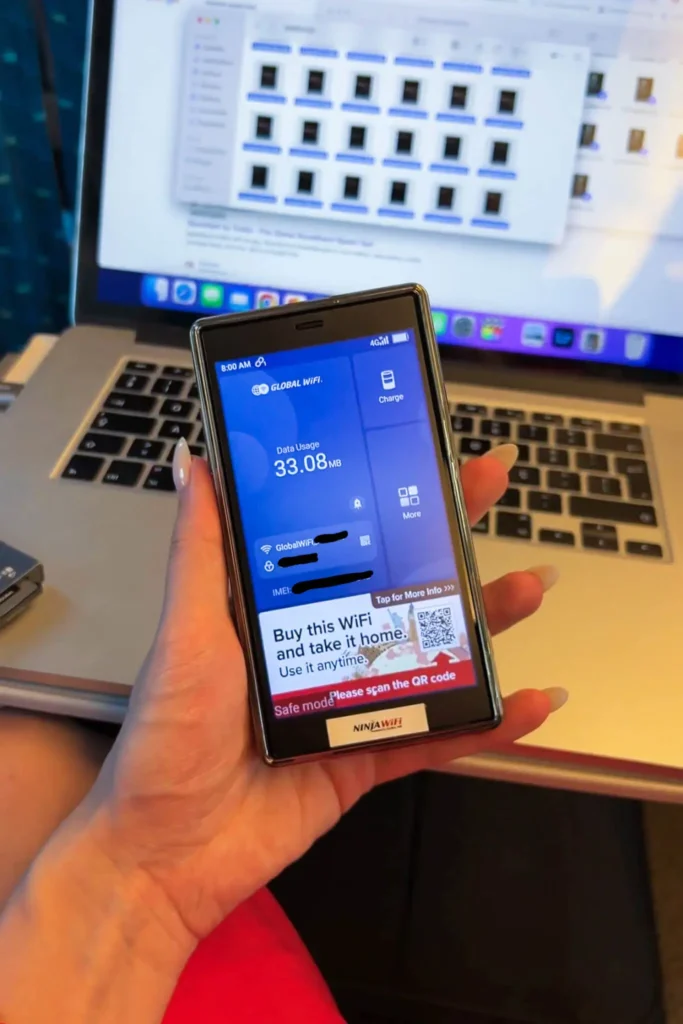
What is a Pocket Wifi and how does it work?
A pocket wifi (also known as a mobile hotspot) is essentially a small, portable wireless router. It uses a SIM card to connect to local 4G or 5G networks and creates a private wifi network that is ideal for connecting to multiple devices like phones, laptops, tablets, or gaming consoles while travelling.
To rent a pocket wifi for the duration of your trip (or part of it), you must pre-order it online up to 4 days before your pick-up date at an airport counter in Japan, or up to 2 days before if you want it delivered to a specific location (within Japan).
The package usually includes the wireless router, a mobile battery (power bank), a charging cable, and instructions for use, pick-up and drop-off.
My experience using a Ninja pocket wifi in Japan
The decision to rent a pocket wifi router for my 5-week Japan trip was very much linked to the fact that both my fiancé and I would need to occasionally check our work devices and attend video calls over this period.
I must admit that, ahead of the trip, I was nervous about being able to successfully connect to the internet or make video calls, since we had planned to stay in some pretty small and remote towns in Japan. I was also worried that the wifi at hotels might not always be great – as even in Europe this can be somewhat hit-or-miss at times.
So, we rented a 4G Ninja pocket wifi alongside our eSIMs for the full duration of our trip. We picked up our package on arrival at Narita Airport, and dropped it off at Haneda Airport before our return flight home. The whole process was pretty smooth, and since we stuck together and always carried a backpack, it wasn’t a problem to keep the router with us throughout the day.
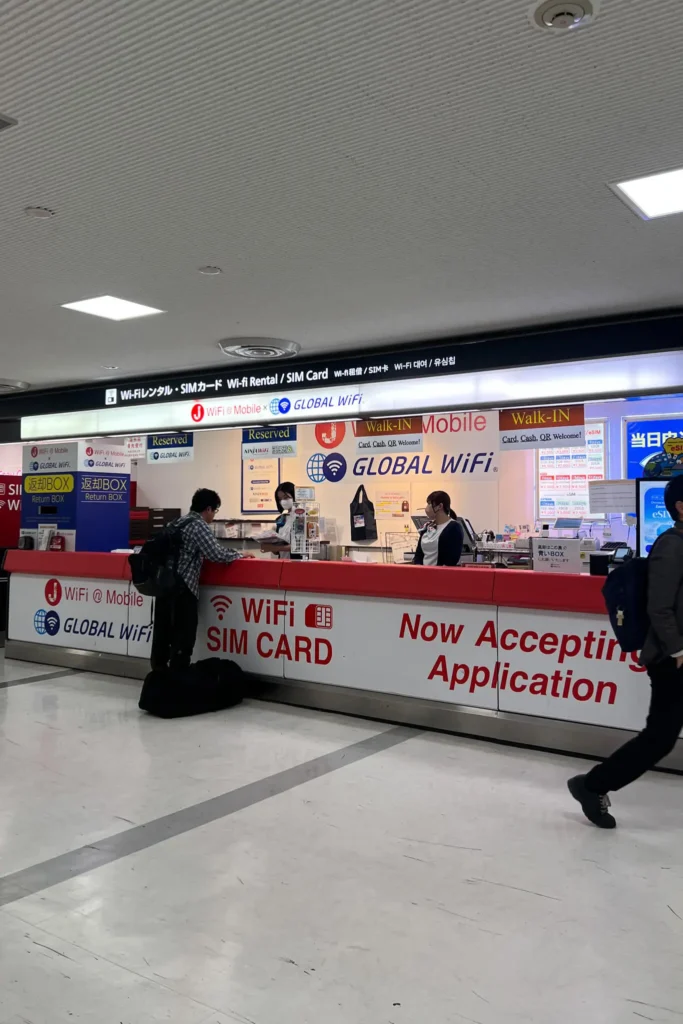
I found that most hotels we stayed in provided decent wifi connection for work (surprisingly, even small stays in remote towns!). However, making video calls was less reliable on both hotel and pocket wifi connections.
We found the pocket wifi connection pretty solid most of the time, but not foolproof. When we stayed in areas with poor cell service (such as in Shirakawago and in Niseko – surprisingly!), the pocket wifi didn’t outperform our eSIMs. I’m not sure if renting a 5G pocket wifi instead of a 4G one would’ve improved our experience by a lot, but next time, I’d definitely go for the upgrade if I needed to make video calls.
However, the pocket wifi was still our preferred option to connect with for video calls and heavy laptop use, as the eSIM hotspot drains smartphone battery quicker. Since we rented a device with an unlimited data plan, we didn’t have to worry about estimating data usage needs, either.
2) Holafly eSIM
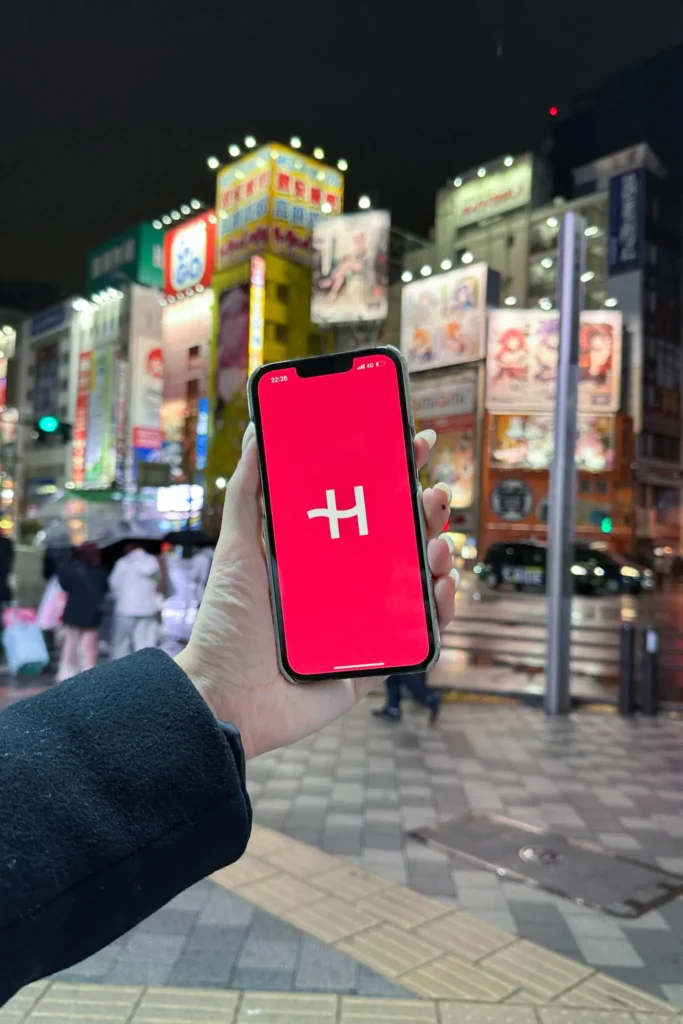
What is an eSIM and how does it work?
An eSIM (short for embedded SIM) works just like a physical SIM card, but it’s completely virtual. It avoids the awkwardness of looking for a SIM card when you land in a new destination, and fiddling with SIM card slots (which some phones don’t even have anymore!).
When you buy a Holafly eSIM, you select the eSIM duration (flexible between 1 and 90 days) and you only pay for what you use (the daily price gets cheaper the longer your plan duration is). Since Holafly eSIMs are unlimited, you don’t have to worry about estimating how much data you’ll need during your trip to Japan.
Holafly eSIMs also have the Always On feature, which automatically gives you 1GB/month of free data in 70+ destinations after your eSIM expires. If you go on a longer trip including more countries, you may also consider a Holafly Plan, which is a monthly eSIM subscription that automatically works across 160+ destinations.
If your phone is compatible with eSIM technology and carrier-unlocked, you can purchase the eSIM via the Holafly website or app, install it into your device before your trip, and then activate it once you land in Japan. You can then also turn it on and off whenever you want, directly from your device settings.
Don’t forget you can save 10% off Holafly eSIM Plans (first 12 months) and 5% off individual eSIMs using my discount code “JESSICAVIANA“!
My experience using a Holafly eSIM in Japan
During my time spent exploring Japan, my fiancé and I used an unlimited Holafly Asia eSIM plan, as we had also been travelling in Thailand prior to arriving in Japan. However, Holafly also have a specific unlimited Japan eSIM.
I had installed the eSIM while in Thailand, and as the regional eSIM plan covers both destinations, the service carried over seamlessly without me needing to do anything else once in Japan.
My Japan itinerary included a variety of locations, from the big cities like Tokyo, Kyoto, and Osaka, to smaller remote towns like Koyasan, Yufuin, Shirakawa-go, Shibu Onsen, and Niseko. I was indeed impressed with the data service connection around Japan in general, and in all fairness, most hotels provided good wifi service, even in small towns.
I found that the Holafly eSIM performed very similarly to our pocket wifi most of the time (and sometimes, even outperforming it). There was never really a situation where the eSIM connection failed, and on the rare occasion where we had no network service (pretty much only when we slept in a 400-year-old gassho-style house in Shirakawago), the pocket wifi was equally affected.
Conclusion: is a Pocket WiFi or an eSIM better for your Japan trip?
Choose a Pocket Wifi, if:
– You’re travelling together as a group or family with multiple devices
– Your phone has no eSIM compatibility
– Your phone is carrier-locked
– You’ll need to tether to a computer, tablet, or gaming console regularly
– You’re travelling in Japan for a longer period, or for work
Choose an eSIM, if:
– You’re travelling solo or as a couple
– Your phone has eSIM compatibility
– You’re travelling with few devices (mainly your phone and occasional laptop use)
– You’re travelling light or on a short vacation
– You value portability and don’t want to bother with picking up and returning physical devices
I hope this review is helpful to inform your decision to either rent a pocket wifi or use an eSIM for your trip to Japan!
As I had experience with both options, I wanted to clearly lay out the pros and cons of each one to help you choose the most appropriate and cost-effective one. Please feel free to comment below, should you have any questions about this article.
*This blog post was sponsored by Holafly. However, as always, all opinions and experiences are entirely my own.
Travelling to Japan and wondering whether to choose an eSIM or pocket wifi? Pin this post and refer to it for later!