

If you’re a foodie visiting the United Arab Emirates, I’m sure you’ll want to explore the authentic cuisine and try as many traditional Emirati foods as possible. I’ve compiled this guide including some of the most popular dishes and drinks that you absolutely cannot miss during your trip to the UAE.
Disclosure: This post may contain affiliate links for products or services that I personally endorse and love. Should you make a purchase, I may make a commission at no additional cost to you. Thank you for supporting Jess Eats The World!
What is the traditional food of the UAE?
Emirati food is the food that’s typical from the United Arab Emirates (previously the Trucial States region). While traditional Emirati foods are not as widely-known as some of the cuisines from its Middle Eastern neighbours, like Lebanon, the UAE does have a long and rich gastronomic heritage.
Given the different environments and cultures within the country (from its historically important pearling and fishing industries along the coast, to the nomadic Bedouin communities in the desert), the cuisine of the United Arab Emirates relies on foods from both land and sea.
As such, you will find a mix of fishermen’s, Bedouin, and farmer’s diets comprising the overall traditional cuisine of the UAE. This translates to dishes made with fish from the Persian Gulf, meats (chicken and goat), camel milk, dates, and vegetables, like cucumbers and tomatoes.
Tying the dishes together, the use of spices is very important in Emirati cuisine – the main spices and aromatic herbs used are saffron, cardamom, turmeric, and thyme.
In general, traditional Emirati food is not spicy-hot.
Best Food Tours in the UAE:

Traditional Emirati Foods and Drinks to Try in the UAE
1. Arabic Coffee (Gahwa)

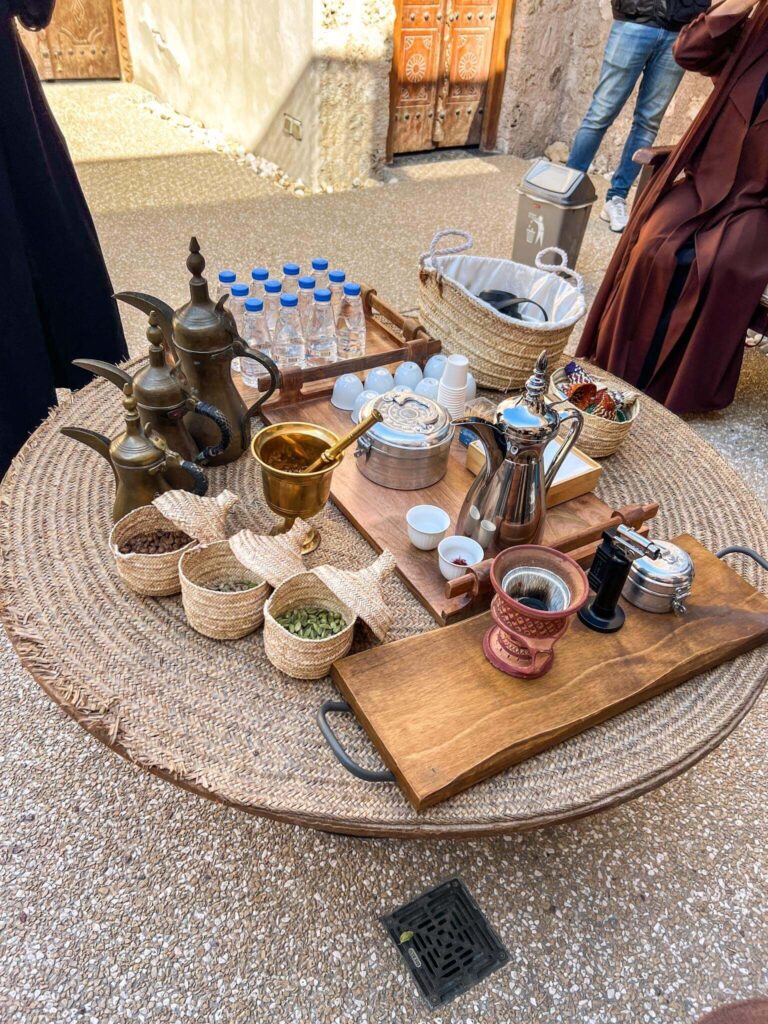
Arabian coffee culture has been an important part of Middle Eastern social and political life for centuries. Serving coffee is an indispensable way of welcoming guests, and one of the most significant gestures in Arab hospitality.
Arabic coffee is known for its dark color and uniquely strong and bitter flavour and smell. Dates are typically served as an accompaniment, as their sweetness balances the bitterness of the coffee.
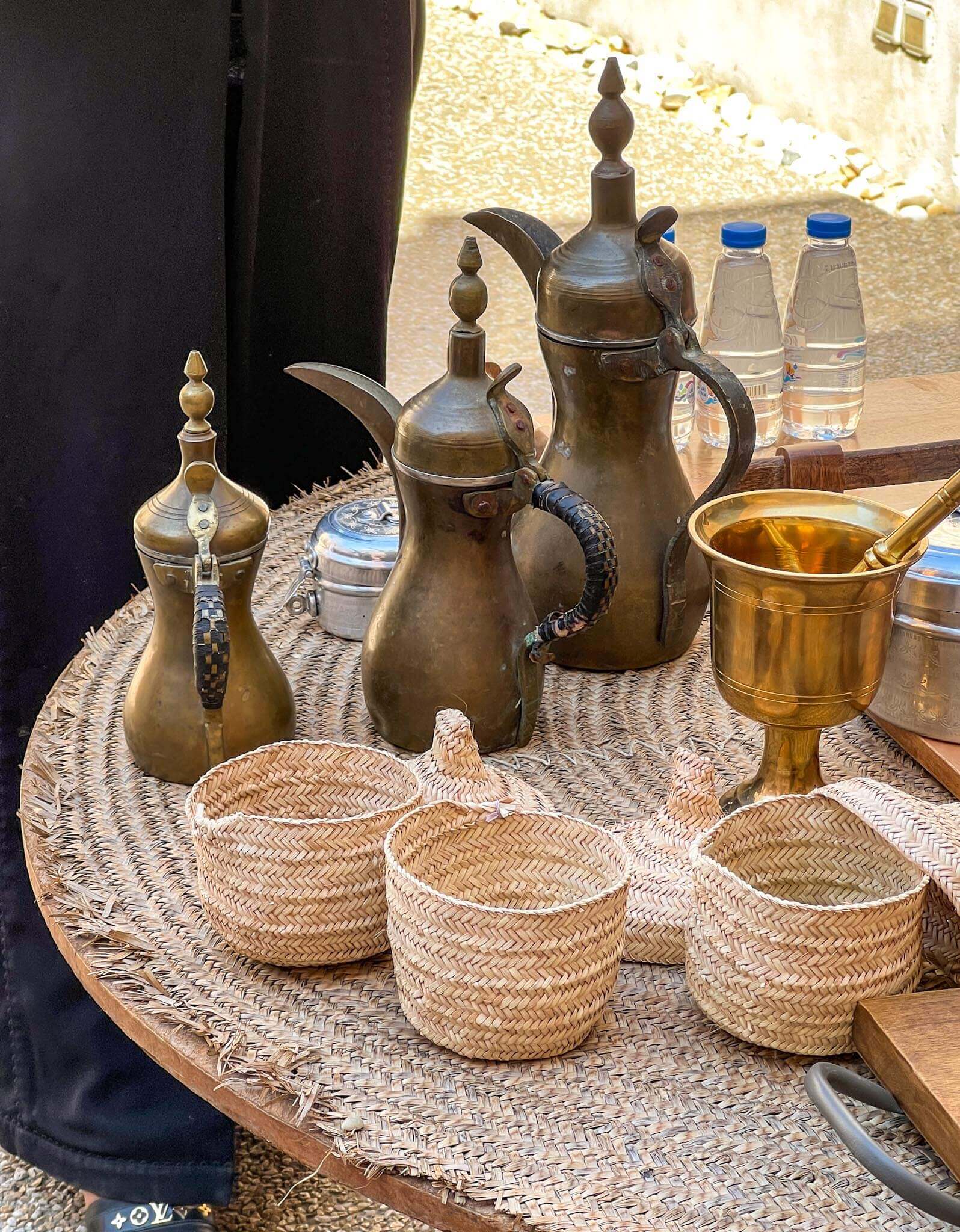
Not all Arabian coffee is made from Arabica coffee beans, but Arabic coffee is. The preparation includes sorting, washing, drying and roasting the coffee beans until they turn brown or red. The ground coffee beans are then brewed using three different types of traditional coffee pots (called “dallah“). The largest pot (dallat al-khumrah) is used for boiling the coffee along with cardamom; the medium-sized pot (dallat al-talgeemah) is used for filtering the coffee; and finally, the smallest pot (dallat al-mazalah) is used for serving the coffee.
Activities to join and learn about Arabic coffee culture:
There are important etiquette rules to follow in Arabic coffee culture for the server, guest, and host. For example, it is polite for guests to always accept at least one cup of coffee, and the oldest or most notable guest is always served first.
The guests must use the right hand to receive and return the cup to the server – usually, the cup is filled up to one-quarter or one-third of the way, and then re-filled; the guest must shake the cup to signal to the server that they do not want any more coffee, otherwise it will be re-filled over and over. If the cup is filled all the way, this is a signal to the guest that they are not welcome, and that they should finish their coffee and leave.
2. Luqaimat / Luqaymat


This is very high on everyone’s favourite Emirati traditional sweet – I know I love them! Luqaimat (or Luqaymat) are decadent deep-fried dough balls, covered in date syrup. Sometimes, they may also be spiced with cardamom or saffron.
You may recognise these delicious bites if you’ve visited Greece or Turkiyë and tried the typical Loukoumades or Lokma. These sweets all belong to the same family, as they’re known to have appeared in cookery books during the late Abbasid Empire, all the way back in the 13th-century.
3. Balaleet

Balaleet is a sweet and savoury breakfast dish, considered a traditional Emirati food but also popular in other Gulf countries.
The dish is prepared using vermicelli sweetened with sugar, cardamom, and saffron; but oftentimes it may also include butter, rosewater, dried fruits, nuts, and honey. Balaleet can be served plain or topped with an egg omelet, and served hot or cold.
4. Saloona / Salona

I love comforting, saucy dishes, and if you do too you can’t miss the traditional Emirati stew – saloona (or salona). This classic tomato-based stew can be made in a few variations, with the most popular ones being prepared with chicken, lamb, beef, vegetables, or fish.
As such, saloona (or salona) is a hearty dish that can be enjoyed by everyone, and it’s also typical during the Holy Month of Ramadan. It can be eaten on its own, but it’s usually accompanied by rice or bread.
5. Khabisah / Khabees

Khabisah (or Khabees) is a traditional Emirati porridge-like sweet dish, made with toasted flour, ghee, sugar, cardamom and saffron. Finally, the mixture is topped with dried fruits or nuts like grated coconut, raisins, pistachios or almonds, for a popular breakfast or dessert treat.
The dish, and some of its variations, is also popular in other Gulf countries, but it’s considered one of the UAE’s oldest traditional foods, going back several centuries.
6. Namlet

During my group trip to the UAE, there was one clear favourite drink amongst everyone – Namlet. We first tasted this funky drink at one of the shops at the Souk Al Arsah, in Sharjah, and it got us excited like little kids trying it!
The drink has an interesting story, as it was the first soft drink commercialised in the Arabian Gulf – introduced by trade from India around the 1920s. The name is believed to be a corruption of the word for “lemonade”, and the bottle has a fun Codd-neck mechanism with a marble stopper. To drink it, you have to push the marble in and release the fizz with a resounding pop.
For a while, it was one of the most popular drinks in the UAE region, but fell into obscurity by the 70s. That was until Mr. Hamed Hareb, owner of several restaurants in the UAE, decided to bring Namlet back and start producing it.
While the original flavours included lemon, orange, and rose, nowadays you can find an endless list of flavours available. We spotted at least 10 flavours, from Kiwi Lemon to Pineapple, Mango, and many others!
7. Khuzi
Khuzi is considered the national dish of the UAE. It’s a spiced dish of roasted mutton/lamb served over fragrant rice and topped with roasted hazelnuts, dried fruits, and potatoes. The spices used are typically cardamom, saffron, cinnamon, and nutmeg.
The dish is also commonly served alongside other sides, like roasted vegetables, yoghurt sauce, and traditional bread. Although Khuzi is typically served at special events, you can find it in many restaurants all-year-round.
8. Karak Chai

While karak tea was introduced in the UAE via the trade with India in the 1960s, it has become such a beloved beverage in the country that it’s now part of the list of the most popular Emirati drinks!
Karak Chai means “strong tea”, and although it may not be as strong or spiced as the teas back in India, this aromatic milk tea variation is a warm hug for the soul. The tea is spiced with cardamom and saffron, and then sweetened with sugar and evaporated or condensed milk.
9. Grilled Fish

As mentioned earlier, the centuries-long fishing culture of the Gulf coast has been engrained in the UAE’s heritage, making fish an important part of Emirati cuisine. Like many other dishes, you will typically find grilled fish prepared with spices and served over a bed of fragrant rice and vegetables.
In the United Arab Emirates, the most common fish are those which are typical in the Persian Gulf: sea bream, hamour, kofer/koffer, sheri/sherri (Spangled emperor), kingfish, etc.
10. Chebab

These Emirati pancakes are a delight for the senses, and you cannot miss them when you visit the UAE!
As with most traditional Emirati foods, these slightly-fermented pancakes are spiced with cardamom and saffron, and brushed with butter or ghee. They’re an Emirati breakfast staple, but also popular at Suhoor during the Holy Month of Ramadan, and during Eid.
Trust me when I say that these pancakes are even more decadent when you spread cream cheese and drizzle date syrup over them. Y-U-M!
11. Regag


Regag is a popular Emirati street snack, and I think it’s safe to say it’s the UAE’s version of a French crêpe. Although it’s usually referred to as a type of bread, the final result is a very thin envelope which can be filled with a multitude of toppings.
I tried Regag for the first time at the Sharjah Light Festival, and the lady served it to me filled with egg and cream cheese. It was delicious!
You can also have sweet variations, with toppings like honey or Nutella, or even heartier versions, like kebab or fish sauce and chips.
12. Harees

Harees is another very popular food in the UAE – although not exclusively an Emirati dish, as you can also find similar variations in Armenian, Kashmiri, and Indian cuisines.
The dish has a porridge-like consistency and it’s prepared by cooking wheat, salted water, and deboned meat (chicken or lamb) for many hours, and then blended into a thick paste. It’s then topped with ghee, melted butter, or a pattern of sprinkled cinnamon.
Harees is often served at important events or important holidays, and especially during the Holy Month of Ramadan and Eid, but it can also be found year-round in various restaurants, served as an appetizer or as a breakfast or dinner dish.
What are the prices for food and drink in the UAE?
The cost of food in the UAE will largely vary depending on where you are, and also on the kind of establishment you choose to dine at. As such, food and drink in the UAE can range from generally affordable to extravagantly expensive.
For reference, in Dubai, you may find street food restaurants where a meal costs 10 GBP or less, and traditional Emirati restaurants where you may spend between 20-25 GBP per person. Of course, in the large Emirati megacities you’ll never be short of choice, and the sky really is the limit when it comes to how much you’d be able to spend on dining.
Where to try traditional foods in the UAE?
If you’d like to discover and sample all the popular Emirati foods, you can do so on your own by going to local traditional restaurants, or you can also jump on a food tour or a traditional food cooking class.
Traditional Emirati Food Tours and Activities
In my opinion, cooking a country’s traditional food is one of the best ways to familiarise yourself with its history and culture. Cooking classes often also introduce you to local people who love to share their norms, customs, and sometimes even their homes – while teaching you all about their typical dishes.
Choose from these best-rated Emirati food tours and traditional cooking classes:
Traditional Emirati Food Restaurants in the UAE
Arabian Tea House
4.7 ★ | Emirati cuisine | Dubai, Sharjah | €€
Concept: After opening its first branch in Dubai in 1997, the Arabian Tea House has established itself as a cultural and heritage reference point for visitors, serving a variety of traditional Emirati foods and Middle Eastern dishes.
What to order: Most of the items on this article! The Arabian Tea House menu has an extensive offer of traditional Emirati dishes and drinks, with delicious and inclusive options for most people – including kids!
Address: Several branches in Dubai and Sharjah
Contact: https://arabianteahouse.com/

Logma
4.2 ★ | Emirati and Middle Eastern cuisine | Dubai | €€
Concept: Traditional restaurant very-centrally located in Dubai Mall, with exterior seating and view over the fountains.
What to order: The menu has plenty of choice for traditional Emirati foods, as well as Middle Eastern food. From typical Emirati breakfast to lunch and dinner plates, the food quality is good and I recommend finishing the meal with a dose of luqaimat and karak chai.
Address: Unit TF – 004 – Financial Center Rd – Downtown Dubai
Contact: +971 42415557

Al Mrzab Traditional Restaurant
4.5 ★ | Emirati cuisine | Abu Dhabi | €€-€€€
Concept: Traditional Emirati restaurant serving local dishes, very popular with locals.
What to order: The menu is full of traditional Emirati foods – let yourself get lost between the harees and the saloona, or the grilled sea bream!
Address: Airport Road, behind the National Theatre – Abu Dhabi
Contact: +971 2 666 2333
Final thoughts
I hope this post about Emirati traditional foods and where to eat them is helpful for your travels! There is a lot more of Emirati cuisine that you can discover in the United Arab Emirates, but this list is a good start.
If you have questions about any part of this article, feel free to reach out in the comments below!
Visiting the United Arab Emirates soon and looking for traditional foods to try? Pin this post to save it for later!


*This article was possible as part of a previous media trip with Visit Sharjah. However, I was not requested or obliged to write this article. As always, all opinions are entirely my own and without bias.



I love traditional Emirati food. Whenever I come to Dubai, I always look for new and interesting restaurants.